Christensen’s Phenomenon: Mastering Prosthodontics\n\n## Unveiling Christensen’s Phenomenon: A Prosthodontic Essential\n\nHey guys, let’s dive into something super important in the world of
prosthodontics
:
Christensen’s Phenomenon
. If you’re looking to truly
master prosthodontics
and create dental prostheses that are not just functional but also incredibly comfortable and long-lasting for your patients, understanding this concept is absolutely non-negotiable. It’s one of those foundational principles that helps us bridge the gap between theoretical knowledge and real-world clinical success. Essentially,
Christensen’s Phenomenon
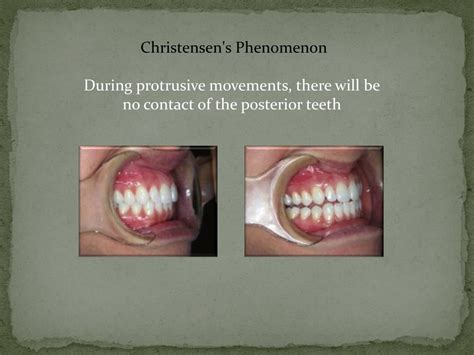
refers to the space that develops between the posterior teeth when the mandible (your lower jaw, for those new to the lingo) moves forward from its centric position, especially during protrusive movements. Imagine biting down, then sliding your lower jaw forward – that little gap at the back? Yep, that’s what we’re talking about!\n\nThis phenomenon is a critical consideration for anyone involved in designing or fabricating
dental prostheses
, whether we’re talking about
complete dentures
,
fixed partial dentures
, or even complex
implant-supported restorations
. Ignoring it can lead to a whole host of issues, from unstable prostheses that click and wobble, to uneven occlusal forces that can cause discomfort, pain, and even damage to the supporting structures over time. Think about it: if your denture isn’t designed to accommodate this natural jaw movement, it’s going to hit unevenly, creating pressure points and reducing the overall efficiency of chewing. It’s like trying to fit a square peg in a round hole – it just doesn’t work optimally! Our goal in
prosthodontics
is always to achieve a harmonious and stable
occlusion
, which is essentially how your upper and lower teeth meet. This harmonious bite is key to patient satisfaction and the longevity of our work. So, understanding
Christensen’s Phenomenon
isn’t just academic; it’s intensely practical and directly impacts the quality of life for our patients. By grasping this concept early on, we can proactively design prostheses that integrate seamlessly with the patient’s natural jaw movements, ensuring superior function, comfort, and durability. It’s about building a better bite, one perfectly adapted prosthesis at a time. This foundational knowledge really sets the stage for advanced clinical practice, allowing dental professionals to approach complex cases with confidence and precision. Getting this right means fewer adjustments, happier patients, and a reputation for excellence. So, let’s get into the nitty-gritty and see how we can use this knowledge to our advantage, making sure every restoration we craft is a masterpiece of precision and patient-centric design.\n\n## Decoding the Mechanics: Understanding Christensen’s Phenomenon in Depth\n\nAlright, let’s peel back the layers and really dig into the mechanics of
Christensen’s Phenomenon
. At its core, this phenomenon is a direct consequence of our unique craniofacial anatomy and the way our jaw joints, or
temporomandibular joints (TMJs)
, function. When your mandible moves in a
protrusive movement
(meaning, moving forward), the condyles (the rounded ends of your lower jaw bone that sit in the TMJs) slide down and forward along an inclined plane within the joint. This downward and forward path is often referred to as the
condylar guidance
. Because of this
downward and forward movement
of the condyles, the angle formed by the posterior teeth (molars and premolars) and the anterior teeth (incisors and canines) changes. Specifically, the posterior teeth separate, creating a space, while the anterior teeth often remain in contact or come into contact, depending on the anterior guidance. This separation at the back is precisely what we define as
Christensen’s Phenomenon
. It’s a natural, physiological occurrence, not a defect or problem, but something we
must
account for in
prosthodontics
. Understanding the precise path and inclination of
condylar guidance
is absolutely crucial here, as it dictates the extent of the posterior disocclusion. Different individuals will have varying angles of condylar guidance, which means the amount of space created by
Christensen’s Phenomenon
will also vary from person to person. This individual variation highlights why a one-size-fits-all approach simply won’t cut it when designing dental prostheses. We also need to consider the incisal guidance, which is the influence of the anterior teeth on mandibular movements. The interplay between
condylar guidance
and incisal guidance determines the overall movement pattern of the jaw and, consequently, the magnitude of the posterior separation during protrusion. Clinicians often use articulators – mechanical devices that simulate jaw movements – to replicate these individual patient parameters. By programming the articulator with the patient’s specific
condylar guidance
and incisal guidance, dental professionals can accurately anticipate and account for
Christensen’s Phenomenon
during the fabrication process. This meticulous attention to detail ensures that the final prosthesis will function harmoniously within the patient’s unique oral environment, preventing premature occlusal contacts and ensuring even distribution of forces. Without this detailed understanding and application, any dental prosthesis, particularly complete dentures, would be prone to instability and trauma, ultimately compromising its longevity and the patient’s oral health. Therefore, appreciating the biomechanical intricacies of mandibular movement and its impact on occlusal relationships is foundational for achieving predictable and successful
prosthodontic outcomes
. It’s about respecting the body’s natural architecture and building our restorations to complement it, not fight against it.\n\n## The Game-Changer: Why Christensen’s Phenomenon Shapes Prosthodontic Success\n\nAlright, so we know what
Christensen’s Phenomenon
is and how it works, but why is it such a
game-changer
in the realm of
prosthodontics
? This isn’t just some abstract anatomical fact; it has profound, practical implications for every
dental prosthesis
we create. If we don’t properly account for this natural posterior separation during protrusive movements, we’re setting ourselves up for failure, and more importantly, setting our patients up for discomfort and complications. Let’s talk about
complete dentures
first. These are often the most sensitive to occlusal discrepancies. If a denture isn’t designed to allow for
Christensen’s Phenomenon
, when the patient slides their jaw forward, the posterior teeth will prematurely contact. This premature contact will inevitably lead to tipping or dislodgement of the denture, compromising its
stability
and
retention
. Imagine trying to eat with a denture that constantly wobbles or pops out – it’s a nightmare for the patient! Achieving
balanced occlusion
is paramount for complete dentures, meaning that there should be simultaneous contact of opposing teeth in centric relation and during excursive movements (like protrusion and lateral movements). By understanding
Christensen’s Phenomenon
, we can design the occlusal surfaces of the posterior teeth with appropriate compensatory curves (like the curve of Spee and curve of Wilson) and inclines that prevent this posterior disocclusion from causing instability. This thoughtful design ensures that the denture remains stable and functional, greatly enhancing the patient’s ability to chew and speak comfortably.\n\nBeyond dentures, this phenomenon also impacts
fixed partial dentures
and even
implant-supported prostheses
. While these might be more stable due to their attachment, uneven occlusal forces caused by neglecting
Christensen’s Phenomenon
can still lead to significant problems. In
fixed partial dentures
, excessive stress on the posterior retainers during protrusive movements can lead to fracture of the porcelain, loosening of the crowns, or even damage to the abutment teeth. For
implant-supported prostheses
, uneven loading can compromise the longevity of the implants and the prosthetic components, potentially leading to bone loss around the implants or screw loosening. The goal in all these cases is to achieve
occlusal harmony
– a state where all teeth or prosthetic components come together in a balanced and functional manner during all jaw movements. This is why careful planning, diagnostic wax-ups, and the use of articulators are so critical. By simulating the patient’s individual jaw movements on an articulator, the dental technician can precisely sculpt the occlusal surfaces to ensure that
Christensen’s Phenomenon
is accommodated, allowing for smooth, non-interfering excursions. This meticulous approach ensures the longevity of the restoration and, most importantly, the comfort and satisfaction of the patient. It truly is the difference between a restoration that merely
